Why IRATA Certification is Non-Negotiable for Offshore Labour Supply
The offshore environment is one of the most demanding workplaces on the planet. Operating on oil rigs, gas platforms, and wind turbines requires a combination of technical skill and extreme safety awareness. In these remote locations, traditional access methods like scaffolding are often impractical due to space constraints, structural complexity, and the sheer height of the installations.
Rope access has become the primary solution for maintenance, inspection, and repair at sea. However, the high-stakes nature of this work means that training and certification are not merely optional extras: they are the foundation of operational integrity. For any organisation involved in construction labour supply uk, ensuring personnel hold valid IRATA (Industrial Rope Access Trade Association) certification is a non-negotiable requirement.
The Origins of IRATA in the Offshore Sector
IRATA was formed in the late 1980s specifically to address the challenges of the offshore oil and gas industry. Major operators needed a way to perform essential maintenance without the downtime and costs associated with heavy access equipment.
Rope access provided a versatile and efficient alternative, but it required a unified safety standard to manage the inherent risks. Today, IRATA is the global gold standard for rope access safety. Its protocols are adopted by international oil and gas majors, ensuring that every technician on a platform operates under the same rigorous safety framework.
Why IRATA is the Industry Standard
IRATA certification is more than just a certificate of attendance. It represents a comprehensive system of training, assessment, and operational auditing. The system is designed to eliminate human error and ensure that rescue procedures are always in place before work begins.
Rigorous Training and Assessment
- Independent Assessment: Unlike many other certifications, IRATA candidates are assessed by an independent examiner who was not involved in their training. This ensures unbiased verification of competence.
- Physical and Medical Fitness: Candidates must demonstrate physical suitability and pass medical screenings before undergoing training.
- Mandatory Progression: Technicians cannot skip levels. They must log thousands of hours of experience and wait for specific time periods before progressing to advanced supervisory roles.
Global Reciprocity and Compliance
- Uniform Standards: Whether a project is in the North Sea or the Gulf of Mexico, IRATA standards remain consistent.
- Regulatory Alignment: IRATA systems align with UK Health and Safety Executive (HSE) regulations, providing a legal safety net for companies providing site labour hire solutions.
The Three Tiers of IRATA Certification
The IRATA hierarchy ensures that every team has a balanced mix of skills and a high level of oversight. Understanding these levels is crucial for effective construction labour supply uk and ensuring the right personnel are deployed for specific offshore tasks.
Level 1: The Rope Access Technician
A Level 1 technician is capable of performing a wide range of rope access tasks under the direct supervision of an IRATA Level 3. Their training includes:
- Standard rope manoeuvres (ascending, descending, changeovers).
- Inspection of their own personal equipment.
- Assisting in simple rescue procedures.
Level 2: The Experienced Technician
Level 2 technicians are the workhorses of the industry. They possess advanced rigging and rescue skills and can handle more complex tasks, including:
- Hauling systems and tensioned lines.
- Complex rescue scenarios in difficult environments.
- Detailed knowledge of legislation and safety requirements.
Level 3: The Safety Supervisor
The Level 3 supervisor is the most critical role on any offshore project. Every rope access team must be overseen by a Level 3. Their responsibilities include:
- The overall safety of the rope access team.
- Drafting detailed Risk Assessments and Method Statements (RAMS).
- Executing complex rescue plans in the event of an emergency.
- Verifying the logbooks of junior technicians to ensure accurate record-keeping.
Safety Frameworks in Remote Environments
The offshore sector is uniquely hazardous because help is often hours, if not days, away. If an accident occurs on a platform in the middle of the North Sea, the team on-site must be self-sufficient.
Emergency Planning and Rescue
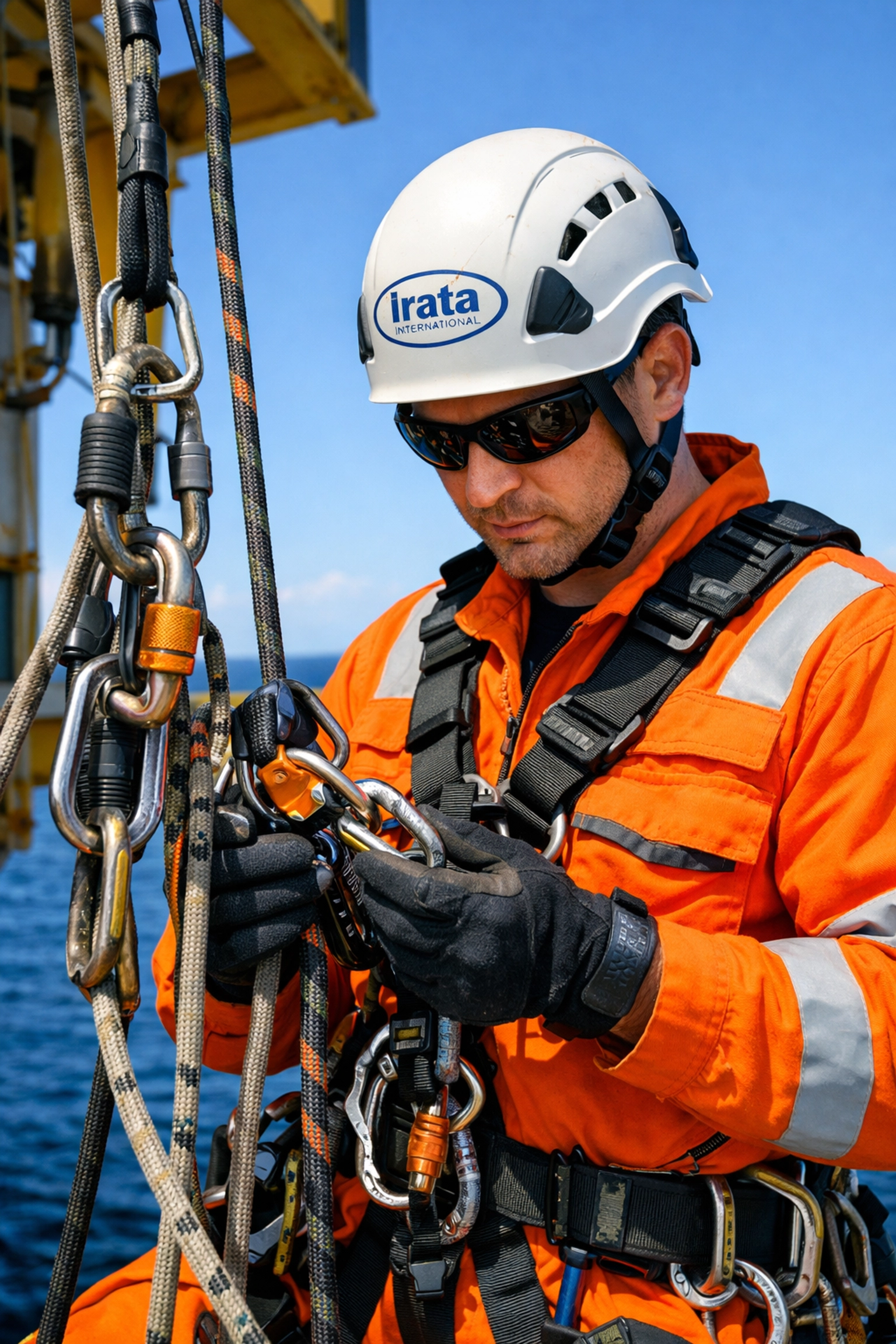
IRATA protocols mandate that a rescue plan must be in place for every single task. This "self-rescue" capability means that if a technician becomes incapacitated on the ropes, their colleagues are trained to reach them, stabilize them, and lower them to safety within minutes. This level of preparedness is why IRATA has maintained an industry-leading safety record for decades.
Equipment Specification
Offshore environments are highly corrosive. IRATA technicians are trained to identify signs of degradation in ropes, carabiners, and harnesses that would be invisible to an untrained eye. Regular equipment inspections are a mandatory part of the daily routine on any offshore installation.
The Role of Alpha Jobs in Specialised Labour Supply
At Alpha Jobs, we understand that providing site labour hire solutions for the offshore sector requires more than just a database of names. It requires a commitment to vetting and quality management.
Our recruitment processes are designed to ensure that every technician we supply holds the necessary IRATA credentials and has the specific offshore experience required for the job. Whether you are looking for electricians in Liverpool or specialised trades in London, the standard of vetting remains the same.
Quality Management and Accreditation
We maintain strict adherence to international standards to ensure the safety of the projects we support.
- ISO 9001:2015: Our certification demonstrates a commitment to quality management and continuous improvement.
- Alcumus SafeContractor: We are vetted for our health and safety practices, ensuring we meet the requirements of top-tier offshore and construction clients.
- TICA Membership: For projects involving thermal insulation, our TICA accreditation ensures that we supply personnel who understand the complexities of industrial insulation in hazardous zones.
Specialised Work Qualifications
Offshore rope access technicians rarely just "climb." They are usually skilled tradespeople who use ropes to reach their work area. Common roles include:
- NDT Inspectors: Non-destructive testing to check for structural cracks in platform legs.
- Thermal Insulation Engineers: Maintaining lagging on high-pressure steam pipes.
- Painters and Blasters: Protecting steelwork from the harsh marine environment.
- Electrical and Mechanical Fitters: Performing essential repairs on platform equipment.
Supplying these dual-skilled professionals is a core part of our construction labour supply uk services. We ensure that a technician is not only IRATA certified but also holds the relevant trade qualifications, such as Thermal Insulation Engineer certificates or electrical time-served credentials.
Accountability and Logbook Verification
One of the unique aspects of IRATA is the logbook system. Every technician must maintain a detailed log of every hour spent on ropes, which must be signed off by an IRATA Level 3 supervisor.
When vetting candidates for site labour hire solutions, we verify these logbooks. This prevents "certification drift," where a technician may hold a valid ticket but hasn't actually been on ropes for several years. Re-certification is required every three years, involving another full week of training and an independent assessment. This ensures that skills stay sharp and safety knowledge remains current.
The Consequences of Non-Compliance
Choosing non-certified or poorly vetted labour for offshore projects carries immense risks:
- Safety Hazards: Lack of rescue knowledge can turn a minor incident into a fatality.
- Legal Liability: Failing to meet industry-standard certifications can lead to massive fines and the suspension of operating licences.
- Operational Downtime: If a technician is found to be unqualified during a site audit, the entire project can be halted immediately.
- Reputational Damage: Major oil and gas companies will not work with contractors who take shortcuts with safety.
Conclusion: A Commitment to Excellence
In the offshore world, there is no room for compromise. IRATA certification is the bedrock of safety for rope access, providing a clear framework for training, supervision, and emergency response.
As a leader in recruitment and staffing, Alpha Jobs is dedicated to supporting the offshore and construction sectors with high-calibre, fully vetted personnel. By prioritizing IRATA standards and maintaining our own rigorous internal accreditations, we help our clients maintain safety at sea and project efficiency on land.
For more information on our recruitment services, visit Alpha Jobs.